
OTH23
Material description
Material ID: OTH23
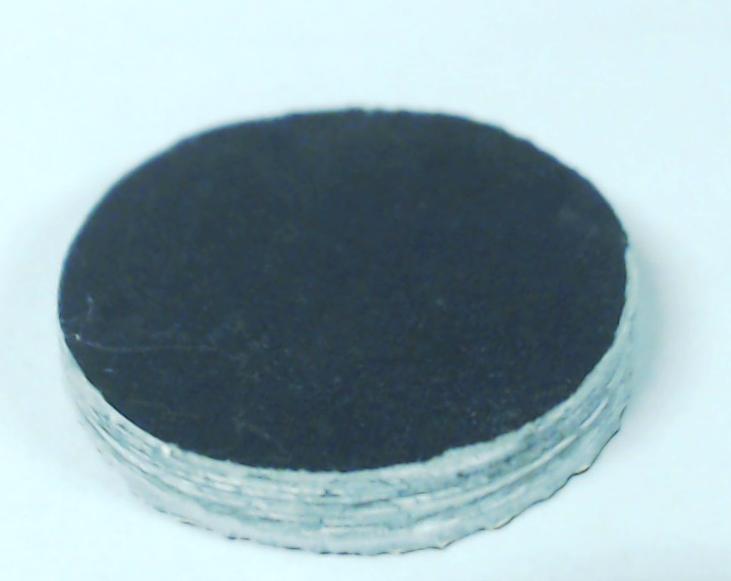
Material type: Glass reinforced polymer composite.
Polymer: Polyester with polystyrene co-polymer (58%)
Additives (fire retardants, fillers or traces of inorganic elements): Silicon Oxide (24%), Bromine (6%), Calcium (4%), Phosphorus (2%), Magnesium (2%), Zinc (2%), Sulfur (1%), traces of other elements (<1%)
Core thickness: 3.87mm
| Compound | Mass Concentration (%) |
|---|---|
| Polyester with polystyrene co-polymer (-) | 58 |
| Silicon Oxide (SiO2) | 24 |
| Bromine (Br) | 6 |
| Calcium (Ca) | 4 |
| Phosphorus (P) | 2 |
| Magnesium (Mg) | 2 |
| Zinc (Zn) | 2 |
| Sulfur (S) | 1 |
| Traces of chlorine (Cl) | <1 |
| Traces of sodium (Na) | <1 |
A. Material composition identification
A.1 Attenuated total reflection – Fourier transform infrared spectroscopy (ATR-FTIR)
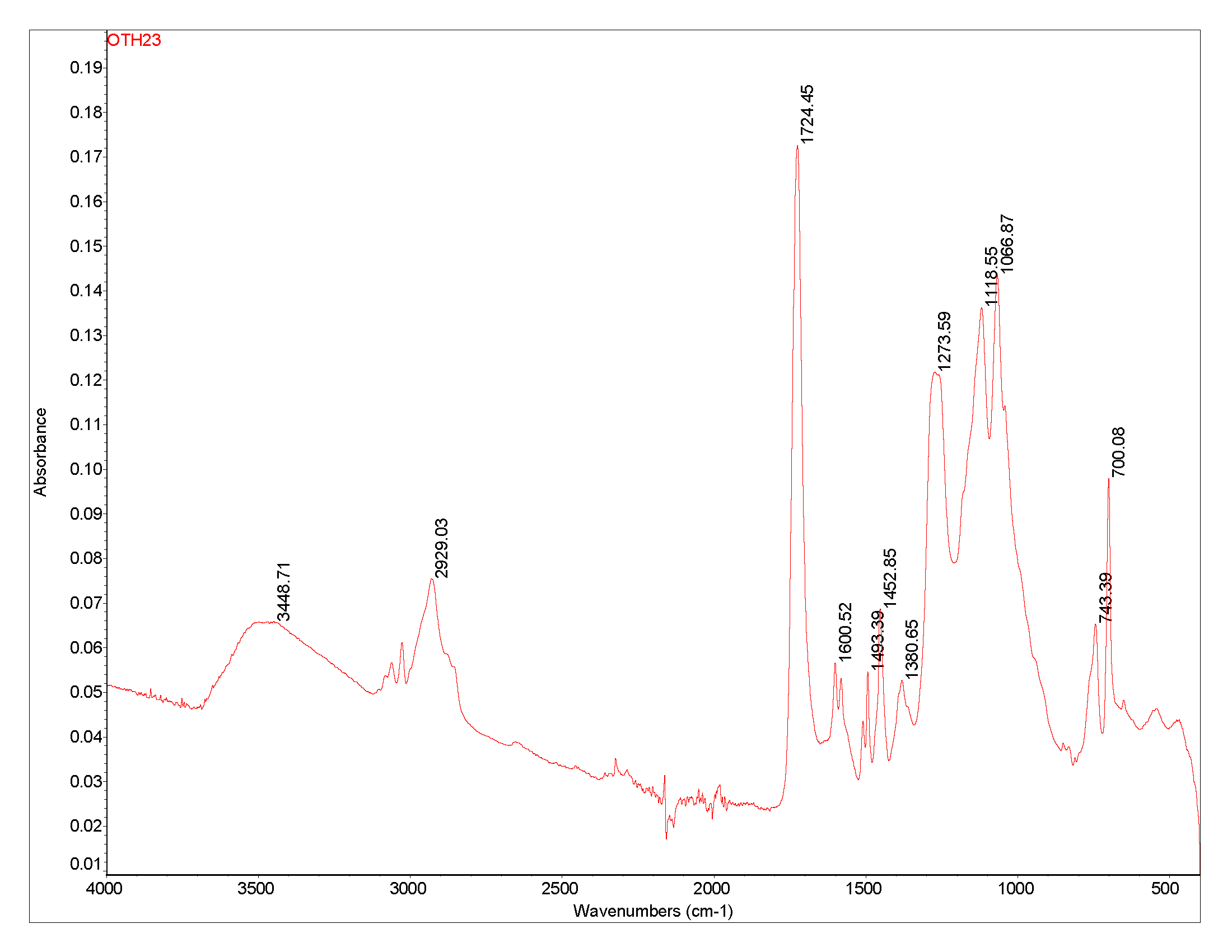
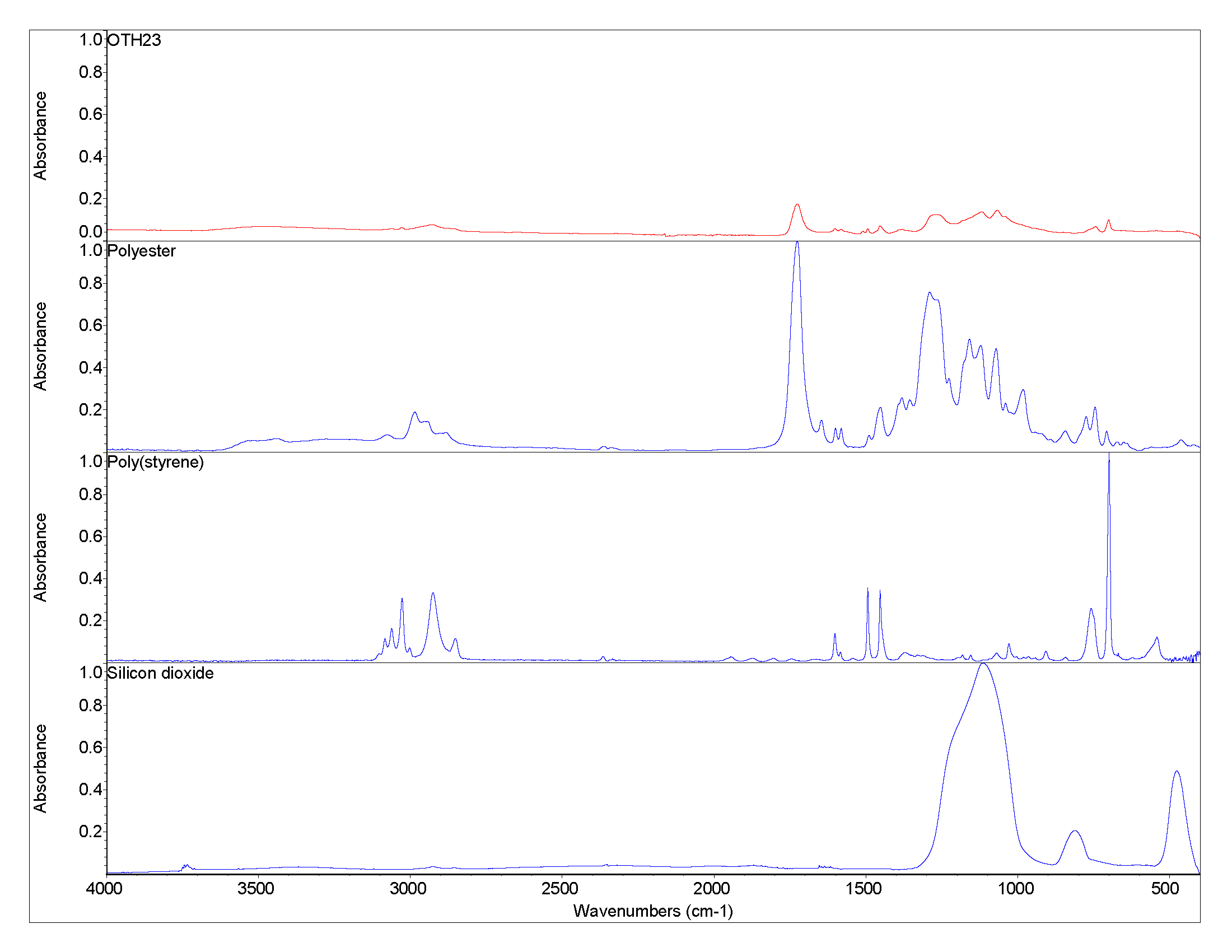
Table 2. FTIR compound identification.| Identified Compounds |
|---|
| Polyester with polystyrene co-polymer (-) |
| Silicon Oxide (SiO2) |
| Bromine (Br) |
A.2 Energy Dispersive X-Ray Fluorescence (EDXRF)
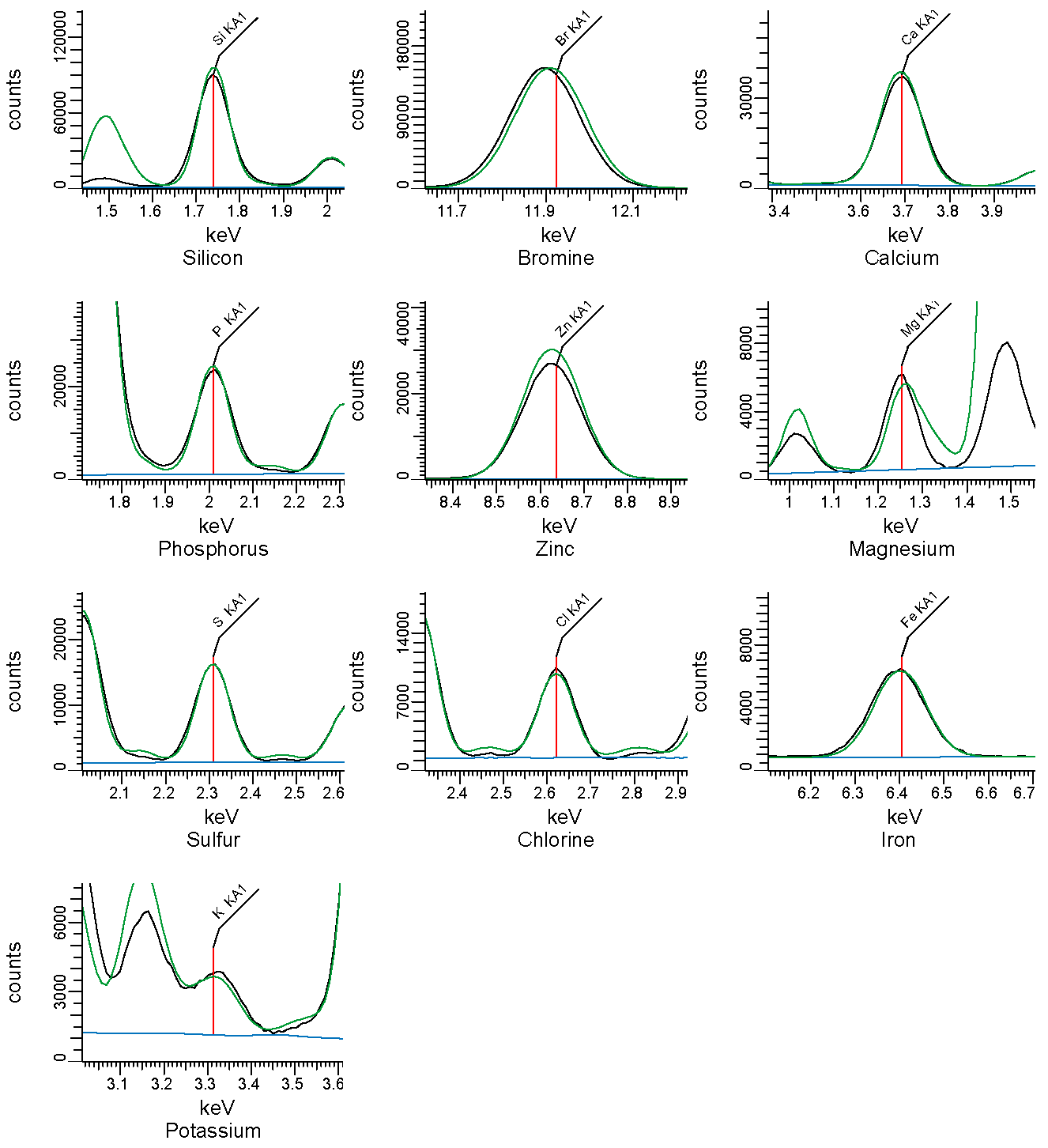
Table 2. Inorganic elements and their mass concentration identified with EDXRF.| Element | Mass Concentration (%) |
|---|---|
| Si | 14 |
| Br | 9 |
| Ca | 5 |
| P | 3 |
| Zn | 3 |
| Mg | 2 |
| S | 1 |
| Cl | 1 |
| Fe | <1 |
| Ti | <1 |
B. Thermogravimetric analysis
Table 3. Mass fraction of residue after thermal decomposition.| Condition | Fraction of mass residue at 800°C |
|---|---|
| Non-oxidative (nitrogen) | 0.48 |
| Oxidative (air) | 0.43 |
| Peak ID | Temperature peak (°C) | Amplitude of peak (°C-1) |
|---|---|---|
| Peak 1 | 381 | 6.54 x 10⁻³ |
| Peak ID | Temperature peak (°C) | Amplitude of peak (°C-1) |
|---|---|---|
| Peak 1 | 364 | 6.8 x 10⁻³ |
| Peak 2 | 462 | 1.86 x 10⁻³ |
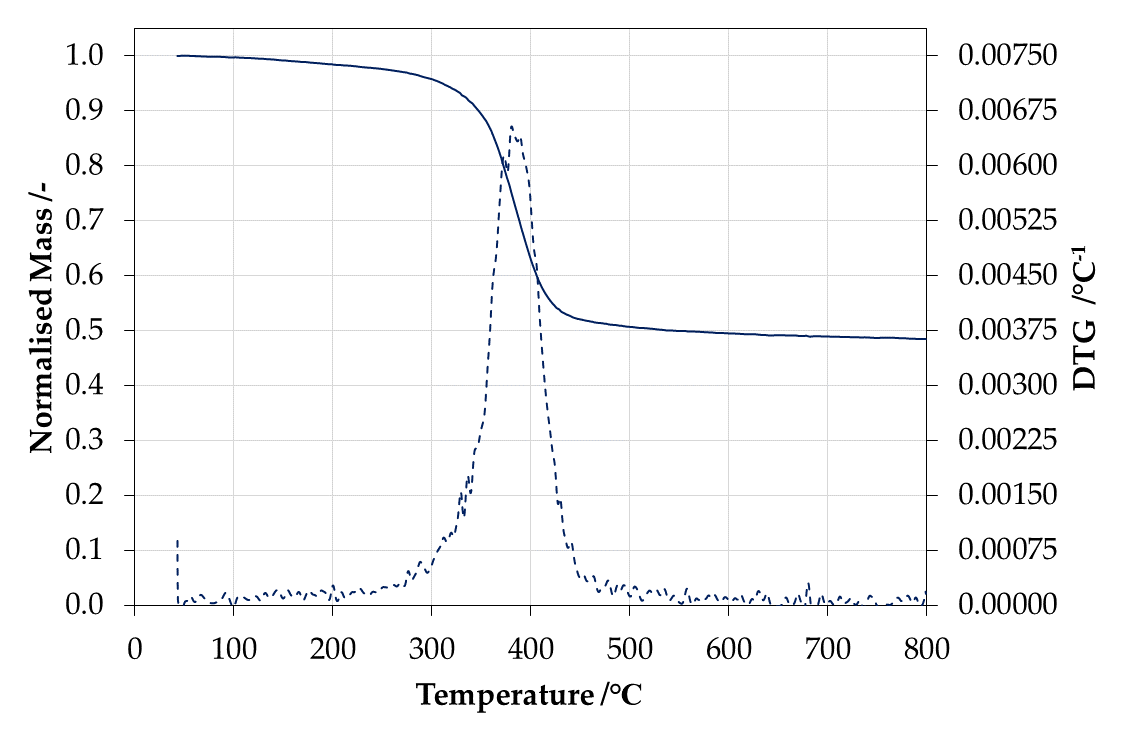
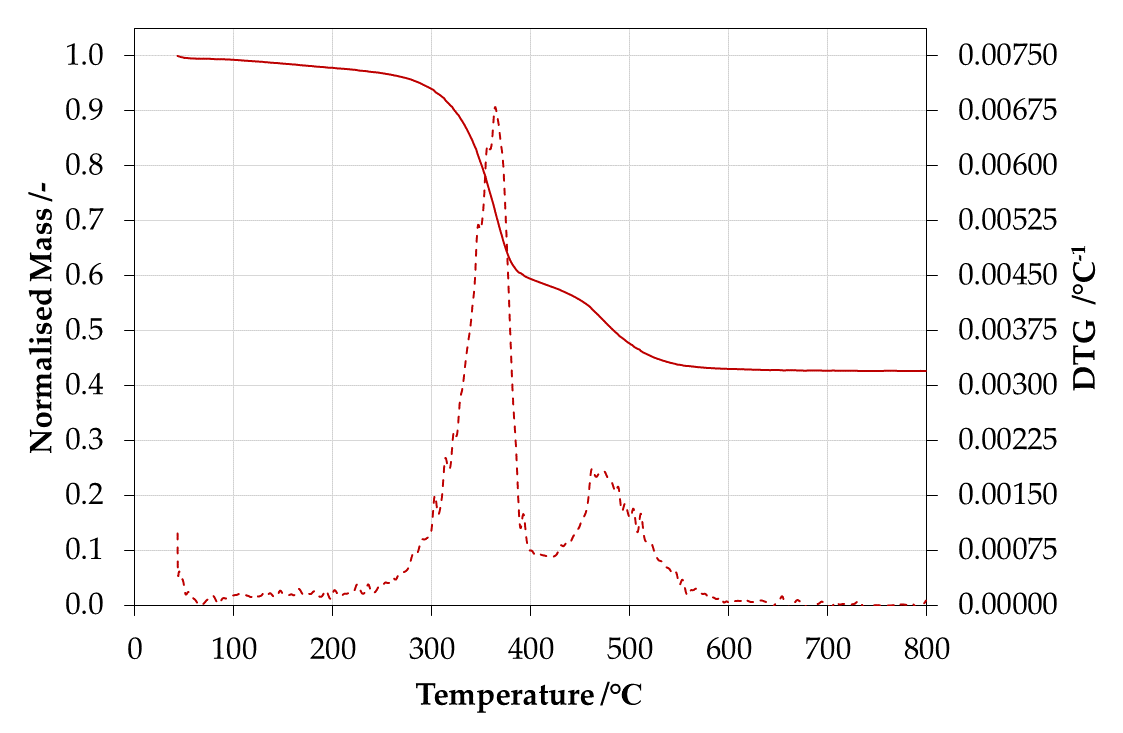
C. Gross Heat of Combustion
Table 7. Gross Heat of Combustion individual results for sample.| Trial | ΔHc [kJ g-1] |
|---|---|
| Trial 1 | 14.20 |
| Trial 2 | 15.33 |
| Trial 3 | 12.94 |
| Average | 14.16 |
| Std dev | 1.20 |
D. Ignition parameters
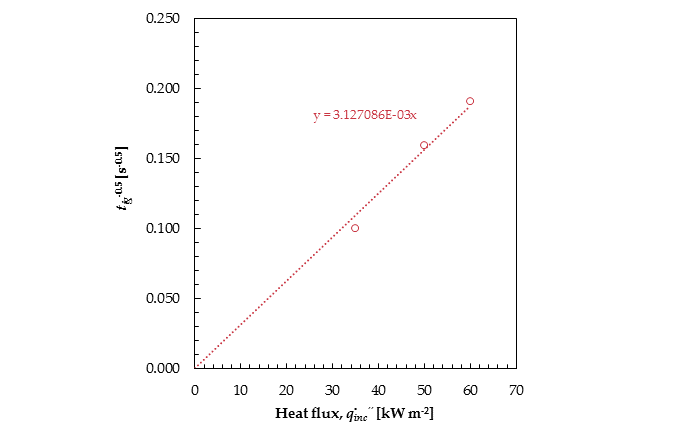
Table 8. Summary of ignition parameters for sample.| Critical heat flux for ignition | Ignition temperature | Total heat transfer coefficient of losses | Apparent thermal inertia |
|---|---|---|---|
| q̇″cr [kW m−2] | Tig [°C] | hr [W m-2 K-1] | kρc [kW2 m-4 K-2 s] |
| 14 | 358 | 37.30 | 0.925 |
E. Burning behaviour
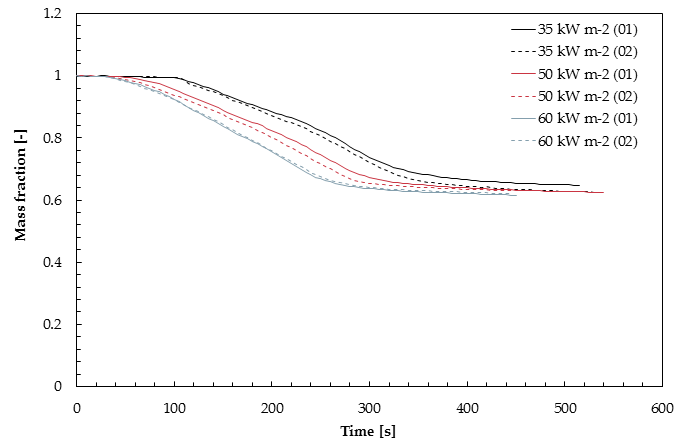
Table 9. Summary of key burning behaviour metrics.| Heat flux | Test | Time to ignition | Fraction of mass residue | Peak heat release rate | Total energy released |
|---|---|---|---|---|---|
| q̇″inc [kW m-2] | tig [s] | mres [-] | q̇″p [kW m-2] | Qt [MJ m-2] | |
| 35 kW m-2 | |||||
| Test 1 | 93 | 0.65 | 274.44 | 58.78 | |
| Test 2 | 106 | 0.62 | 264.35 | 57.11 | |
| Avg | 100 | 0.64 | 269.39 | 57.95 | |
| 50 kW m-2 | |||||
| Test 1 | 44 | 0.62 | 275.85 | 67.50 | |
| Test 2 | 35 | 0.63 | 260.15 | 61.21 | |
| Avg | 40 | 0.63 | 268 | 64.36 | |
| 60 kW m-2 | |||||
| Test 1 | 28 | 0.62 | 296.95 | 61.34 | |
| Test 2 | 27 | 0.62 | 267.35 | 57.24 | |
| Avg | 28 | 0.62 | 282.15 | 59.29 | |
| 80 kW m-2 | |||||
| Test 1 | - | - | - | - | |
| Test 2 | - | - | - | - | |
| Avg | - | - | - | - |

| Test | ΔHc [kJ g-1] |
|---|---|
| 35 kW m-2 (Test 1) | 22.45 |
| 35 kW m-2 (Test 2) | 21.57 |
| 50 kW m-2 (Test 1) | 22.73 |
| 50 kW m-2 (Test 2) | 22.29 |
| 60 kW m-2 (Test 1) | 21.43 |
| 60 kW m-2 (Test 2) | 19.95 |
| 80 kW m-2 (Test 1) | - |
| 80 kW m-2 (Test 2) | - |
| Average | 21.74 |
| Std dev | 1.01 |
F. Flame Spread
Table 11. Minimum heat flux for flame spread rate and minimum flame spread rate for sample.| Orientation | q̇″min.spread [kW m-2] | Vf.min [mm s-1] |
|---|---|---|
| Horizontal | 3.40 | - |
| Vertical | 3.20 | - |
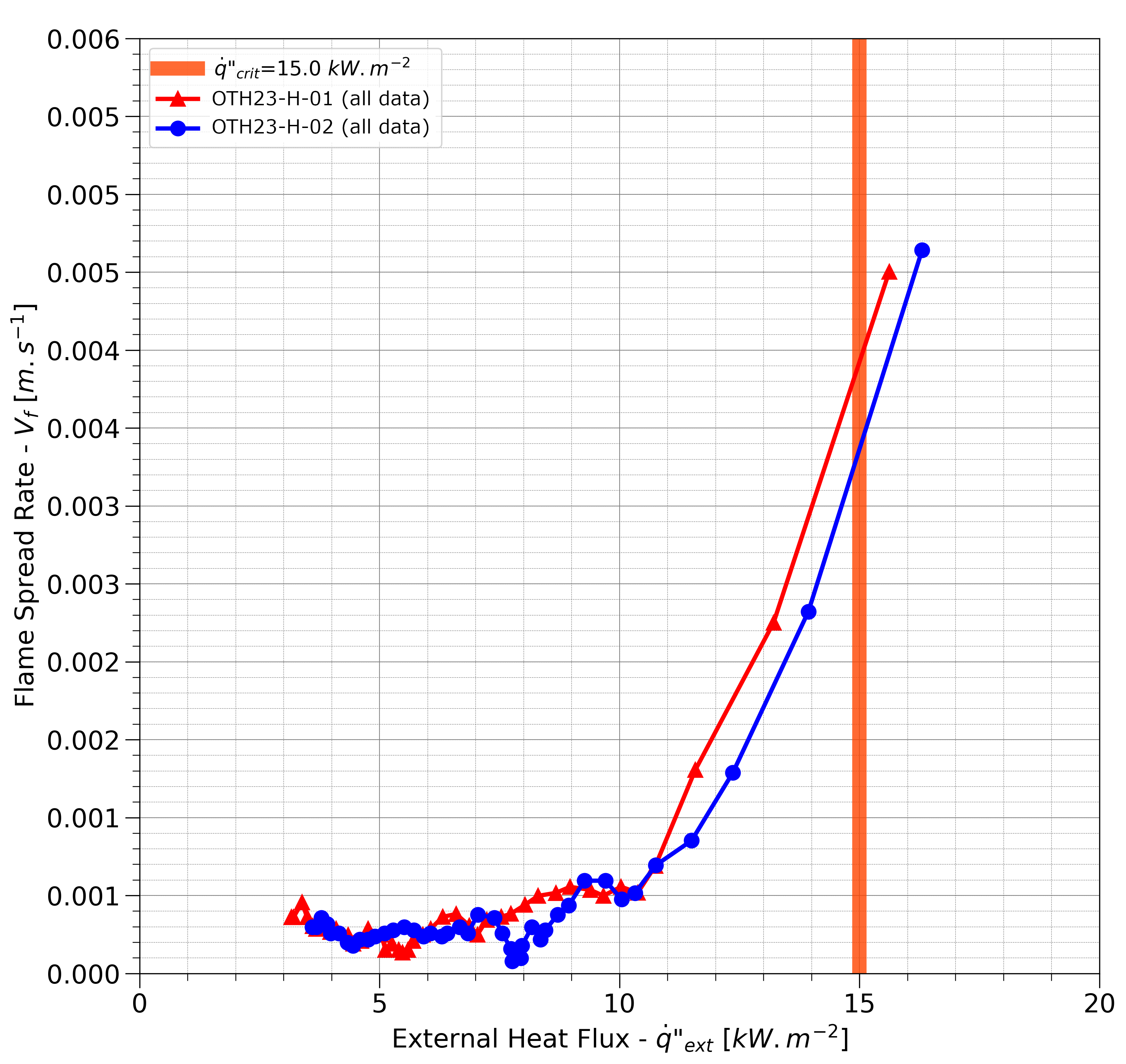
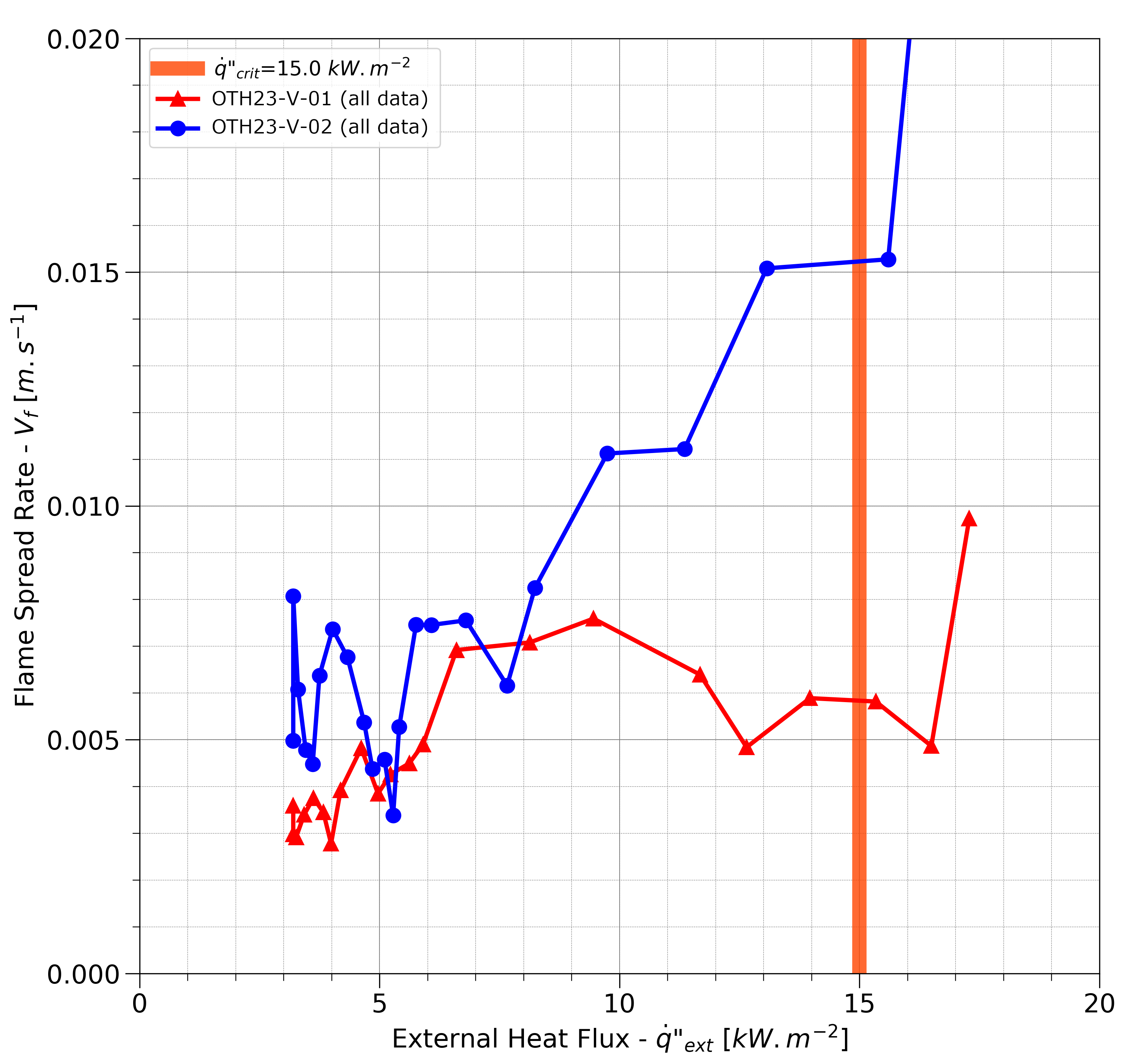
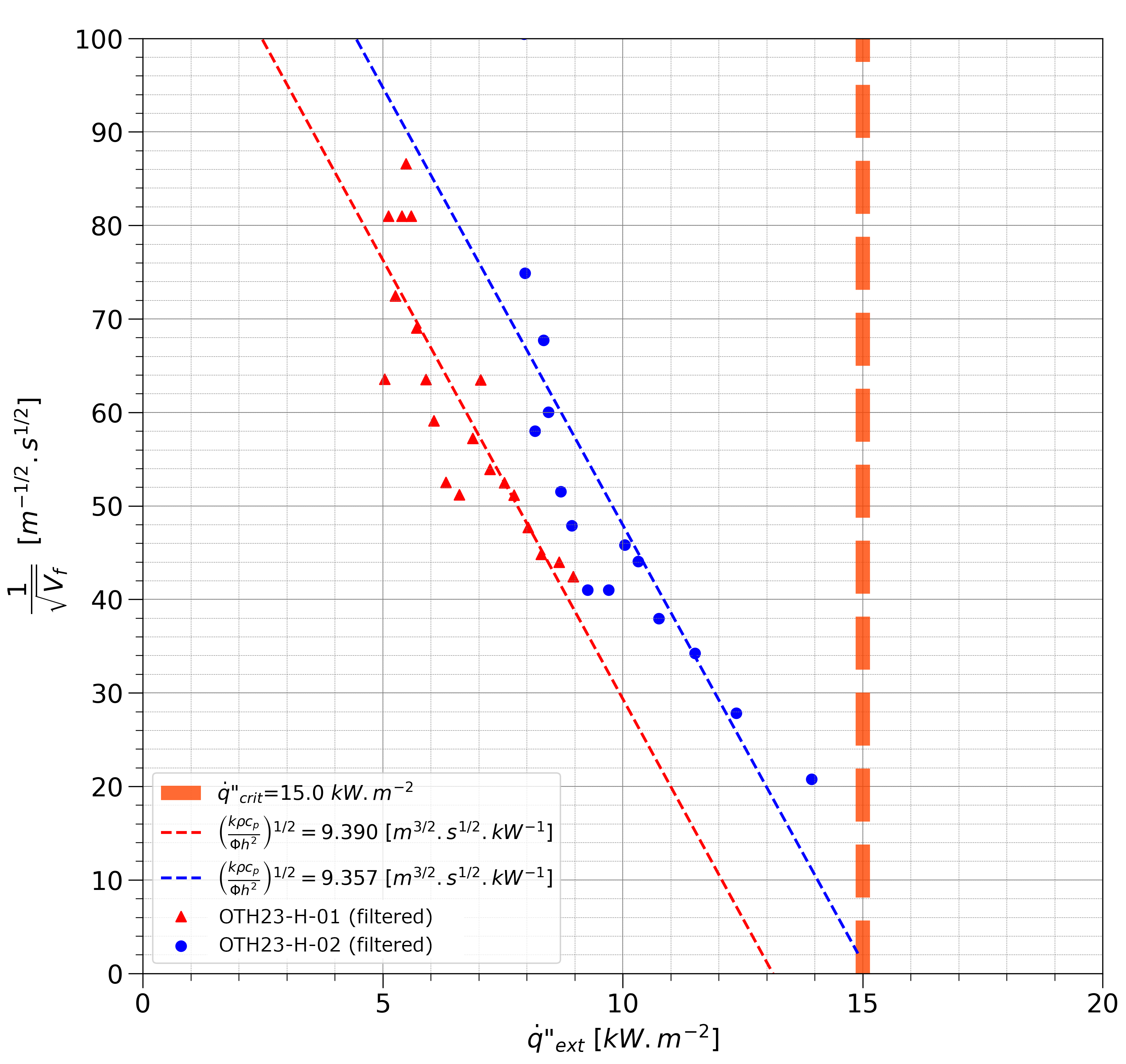
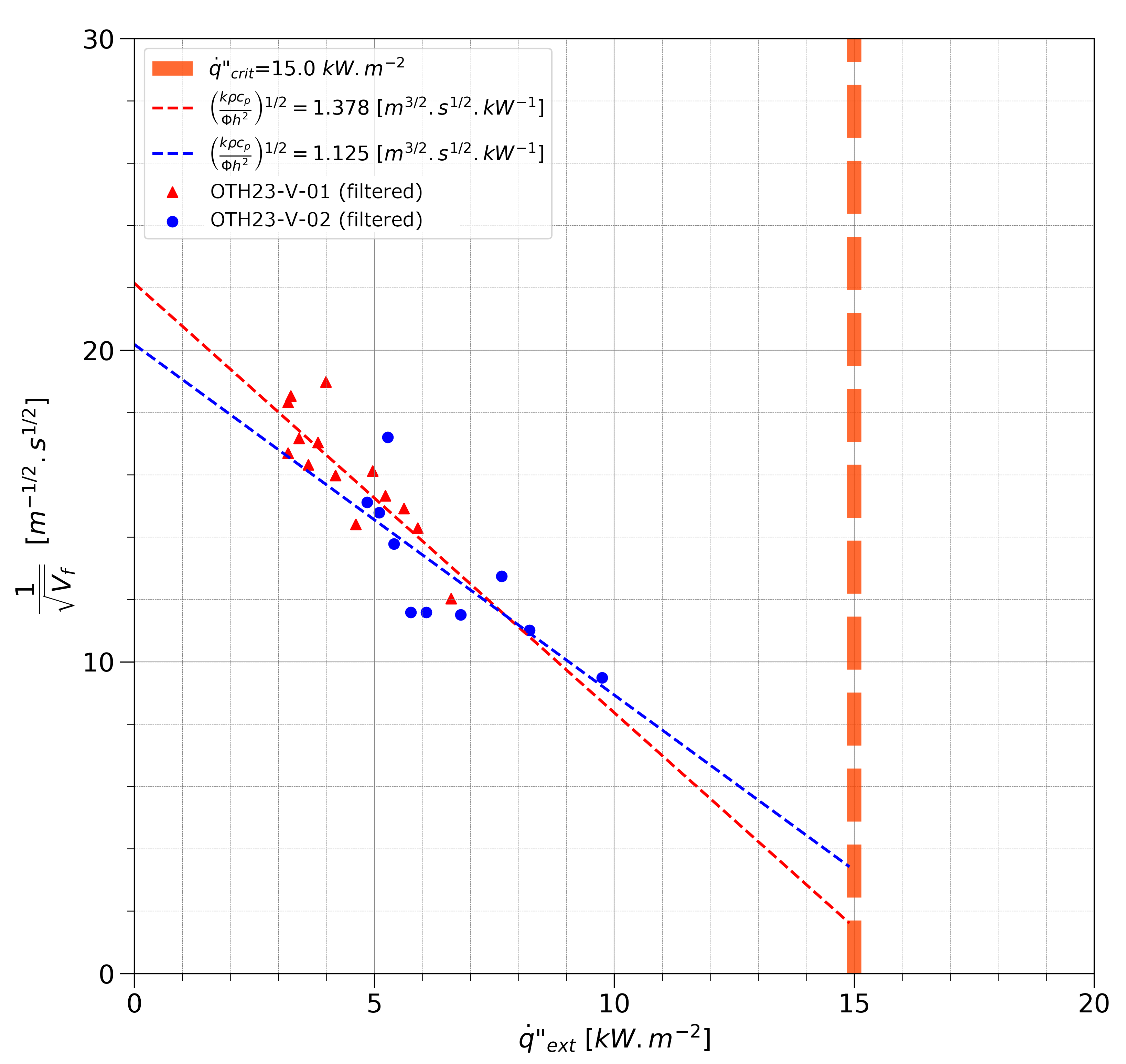
| Orientation | Trial | (kρcp⁄Φh2)1⁄2 [m3⁄2 s1⁄2 kW-1] | Φ [kW2 m-3] |
|---|---|---|---|
| Horizontal | 1 | 9.39 | 11.99 |
| Horizontal | 2 | 9.357 | 12.07 |
| Vertical | 1 | 1.378 | 999 |
| Vertical | 2 | 1.125 | 999 |